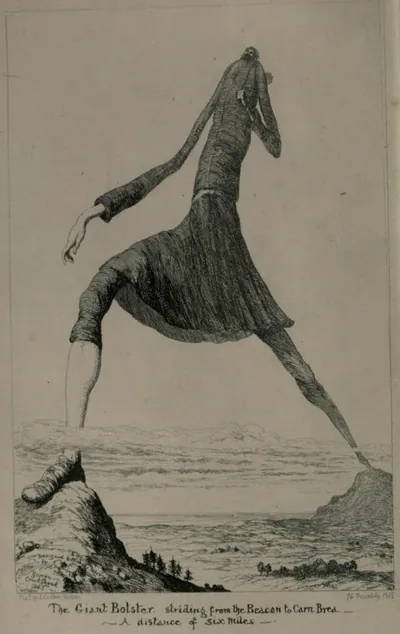
Long ago, people in west Cornwall said, St Michael's Mount was not an island at all. It stood far inland, some six miles from the sea, a pale rock rising out of a great forest. In Cornish it was called the White Rock in the Wood.
In that wood lived the giant Cormoran, and he wanted a home tall enough to look out over the treetops at all the country round. So he set about building one. He picked out blocks of white granite from the hills nearby, square and solid, and carried them through the forest, piling them one upon another. It was slow, heavy work, and he made his wife, the giantess Cormelian, help him.
Cormelian had the heaviest loads, and carried the great stones in her apron. Close to the building there was a mass of greenstone, and she couldn't see why one kind of stone wouldn't do as well as another. So one day, while Cormoran lay asleep, she broke off a huge lump of the greenstone, put it in her apron and hurried towards the half-built hill, hoping to slip it in before he noticed.
She very nearly managed it. But just short of the White Rock the giant woke, and saw at once that she was carrying a green stone instead of a white one. Up he jumped in a fury, strode after her and gave her a kick. Her apron-string snapped, and the greenstone fell onto the sand.
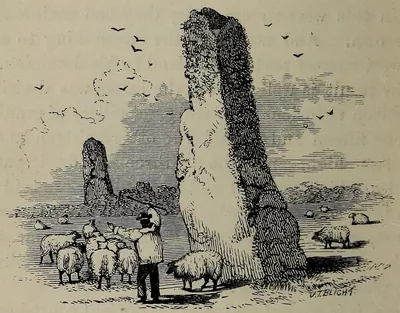
There it has stayed ever since, for no one has ever been strong enough to move it. Poor Cormelian never got over it, the story goes, and the stone became her monument. Long afterwards, when Christianity came to Cornwall, people built a little chapel on it, and that is why it is still called Chapel Rock.
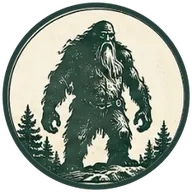
Cormoran lived on in his hill of stone. The old chapbook says he was eighteen feet tall and three yards round, with a fierce, grim face. He lived in a cave in the middle of the Mount, and whenever he was hungry he waded across to the mainland. The people ran from their houses when they saw him coming, and he took their cattle, half a dozen oxen at a time on his back, with sheep and pigs tied round his waist like a bunch of candles. He did this for so many years that all Cornwall grew poor.
At last a farmer's son called Jack, from near the Land's End, said he would put a stop to it. One dark winter's evening he crossed to the Mount with a horn, a shovel and a pickaxe. All night he dug, until he had a pit twenty-two feet deep, and he covered it with sticks and straw and a sprinkle of earth so that it looked like solid ground. At daybreak he stood on the far side and blew his horn.
Out rushed Cormoran, roaring that he would broil Jack for his breakfast, and straight into the pit he tumbled, so hard that the whole Mount shook. One blow of the pickaxe on the crown of his head, and that was the end of him. Jack filled in the pit, found the giant's treasure in the cave, and was given a sword and a belt with these words stitched on it in gold:
Here's the right valiant Cornish man,Who slew the giant Cormoran.Jack's belt, in the chapbook, as printed by Joseph Jacobs in 1890
From that day he was known as Jack the Giant-killer. And when James Halliwell wrote about the Mount in 1861, people still showed a cistern cut in the rock there, and called it the Giant's Well.