Standing stones · Cornwall

The Men-an-Tol, the Crick-stone

The Men-an-Tol, on the moor between Madron and Morvah, near Penzance

Family-friendlyA 2-minute read

On this page
  1. The tale
  2. What people said
  3. Other tellings
  4. What the history says
  5. Go and see
  6. Explore more folklore
  7. Sources

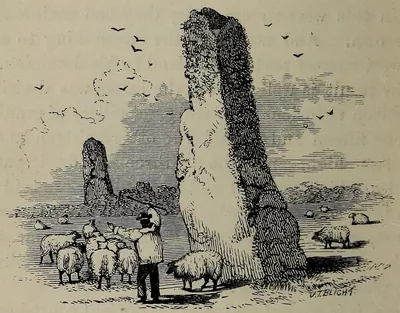
On the moor west of Penzance, beyond the village of Lanyon, a path runs across a furzy down. Beside it stand three stones. Two are rough upright pillars, about four feet high. Between them stands a thin, flat stone with a great round hole through its middle, big enough for a grown person to crawl through. In Cornish it is the Men-an-Tol, the holed stone. The country people had their own name for it: the Crick-stone.

In the year 1749 the antiquary William Borlase, rector of Ludgvan, visited the stones. A sensible farmer from the neighbourhood told him that he had known many people creep through the hole to be cured of pains in their back and limbs. And at certain times of the year, he said, parents would bring their small children and draw them through the stone, to cure them of the rickets.

Then the farmer showed Borlase something more. On the top edge of the holed stone, two pins had been carefully laid, one across the other. This, he explained, was how the curious asked the stone about love and fortune. They would leave the pins and come back later. If the pins still lay as they had been left, or had turned, or had vanished altogether, that was the stone's answer, and they made up their minds accordingly.

More than a hundred years later the stone had lost none of its power, or so people believed. Robert Hunt was told that children with scrofula were passed naked through the hole three times, and then drawn three times across the grass against the sun. Grown men and women with bad backs were drawn through as well, and everyone agreed that the stone was as good as ever. Lay two brass pins crossed on its top, Hunt heard, and ask your question, and the pins would stir and give the answer.

William Bottrell, who grew up in the far west of Cornwall, knew the custom too. To cure lumbago, sciatica and every other crick and pain in the back, you must crawl on all fours through the hole nine times, going against the course of the sun. The old word for this was “crameing”. Little children were put through as well, so that they would grow up strong and healthy.

Why against the sun? Because, people said, going against the sun drives a sickness back. For anything else, you should always go the way the sun goes.
What people said

Beliefs and stories recorded about this place. They are folklore, not fact.

Crawl through for a bad back

Crawling through the hole cured pains in the back and limbs. Thomas Tonkin, whose notes Borlase quotes, says it worked if you went through three, five or nine times; in Bottrell's day it was nine times, crawling on all fours against the sun, for lumbago, sciatica and other “cricks”.

Recorded by Borlase (1769), p. 178 and note; Bottrell (1873), p. 242

Drawn through to grow strong

Parents drew their young children through the stone at certain times of the year to cure them of rickets. Hunt was told that children were passed through naked three times and then drawn three times on the grass against the sun; Bottrell says children were put through to make sure they grew up healthy.

Recorded by Borlase (1754), p. 169; Hunt (1865), p. 191; Bottrell (1873), p. 242

Against the sun

Going against the sun's course was thought to drive a sickness back; for everything else, you followed the sun.

Recorded by Bottrell (1873), p. 242

The crossed pins

Two pins laid crossed on the top edge of the stone would answer questions of love and fortune: whether they stayed put, moved or vanished gave the answer. In Borlase's second edition, and in Hunt's telling, they are brass pins, and Hunt says the pins themselves moved to answer.

Recorded by Borlase (1754), p. 169; Borlase (1769), pp. 178–179; Hunt (1865), p. 191

Crick stones

Country people called the Men-an-Tol the Crick-stone. Other holed stones near Boleigh in St Buryan were called crick stones too, though their holes were too small for any but the smallest baby, and people insisted they had had that name since before they were born.

Recorded by Bottrell (1873), pp. 31 and 242

Other tellings

Beyond the legend

What the history says

When Borlase drew the Men-an-Tol in 1749, he found three stones set on a triangular plan in the tenement of Lanyon, in Madron parish: a thin, flat stone with a hole one foot two inches across, a rough pillar about four feet high on each side, and a long stone lying beside one pillar like a cushion. Later writers wondered whether it marked a burial, and Max Müller suggested in 1867 that it was an ancient sun-dial for finding the autumn equinox, since the three stones lie nearly in a line east to west.

Today the Cornish Ancient Sites Protection Network describes the holed stone as 1.2 metres across, with a hole 51 centimetres wide, between two uprights 1.3 metres high, with a fallen stone and traces of other stones nearby. It thinks these are the remains of a stone circle, probably once of nineteen stones like the other circles of West Penwith, and probably dating from the late Neolithic or early Bronze Age (about 2500–1500 BC). Nobody knows where the holed stone first stood or what it was for: it may have been moved, perhaps turned at right angles, and it may once have been the entrance to a burial mound.

Historic England, which has protected the Men-an-Tol as a scheduled monument since 1926, dates stone settings like it more widely, to between the late Neolithic and the middle Bronze Age (about 2500–1000 BC), and calls it one of the most famous and mysterious monuments in Cornwall. The stones were recorded where they stand now in 1825, but one of the uprights is thought to have been moved in the last few hundred years, to make the stones look more like a line. W. C. Borlase dug a trench between the stones and found only a single flake of flint. When the Cornwall Archaeological Unit surveyed the site in 1992, before strengthening the stones against wear from visitors, it found that a nearby pit and spoil heap were left by someone prospecting for minerals, and it found other fallen stones close by.

Go and See

Where
Beside a path leading off the minor road from Madron, near Penzance, to Morvah on the north coast (grid reference SW 4264 3493).
Opening
A small parking area beside the road, then a walk of about half a mile up the lane. The stones are signposted on the right of the lane, over a stile in the hedge. The Cornish Ancient Sites Protection Network gives no opening times or charges.
Parking
A small parking area beside the road.
Access
The stile in the hedge makes it unsuitable for wheelchairs.
Dogs
Keep dogs under effective control and on a lead around farm animals, as the Countryside Code asks, and bag and bin their mess.
Families
A gentle tale, fine for young children, with a half-mile walk up a lane and a stile to climb.

Visiting details checked 2 November 2026 with Cornish Ancient Sites Protection Network. Always check before you travel.

50.1584° N, 5.6046° W · Open in OpenStreetMap

Explore more folklore

All standing stones · All Cornwall legends · The map

Sources

Old books and records

  1. William Borlase, Observations on the Antiquities Historical and Monumental, of the County of Cornwall (1754), pp. 168–169 and Plate XII. The earliest account we have found: the farmer Borlase met at the stone in 1749. Internet Archive.
  2. William Borlase, Antiquities, Historical and Monumental, of the County of Cornwall (1754; second edition, revised and enlarged, 1769), pp. 177–179 and Plate XIV. Second edition, adding Thomas Tonkin's manuscript note and the brass pins. Internet Archive.
  3. Robert Hunt, Popular Romances of the West of England; or, The Drolls, Traditions, and Superstitions of Old Cornwall (first series, 1865), pp. 191–192. Internet Archive.
  4. William Bottrell, Traditions and Hearthside Stories of West Cornwall (second series, with illustrations by Joseph Blight, 1873), pp. 31, 242 and 280–282. “The Crick-stone, or Men-an-tol”, and J. T. Blight on holed stones. Internet Archive.

Places and archaeology

  1. Historic England, “Stone setting and holed stone known as the Men-an-Tol, 315m south east of Coronation Farm”, National Heritage List for England, entry 1004641. Scheduling, dating and the site's later history. Checked 3 November 2026. historicengland.org.uk.

Visiting information

  1. Cornish Ancient Sites Protection Network, “Mên-an-Tol”. Description, dating and visiting details. Checked 2 November 2026. cornishancientsites.com.
  2. Natural England and Natural Resources Wales, “The Countryside Code: advice for countryside visitors”, GOV.UK. Dogs on paths and farmland. Checked 2 November 2026. gov.uk.

Pictures

  1. Picture: The Men-an-Tol, from William Borlase, Antiquities of Cornwall (1769). Public domain, via the Internet Archive.

This is a legend, told as people told it. Spotted something wrong? Tell us.