Standing stones · Cornwall

The Merry Maidens and the Pipers

The Merry Maidens stone circle (Dans Maen) and the Pipers, at Boleigh near St Buryan, West Penwith

Family-friendlyA 2-minute read

On this page
  1. The tale
  2. What people said
  3. Other tellings
  4. What the history says
  5. Go and see
  6. Explore more folklore
  7. Sources

Down in the far west of Cornwall, a few miles from Penzance, there is a field near St Buryan with a ring of grey stones standing in it. There are nineteen of them, none much taller than a child, set out evenly in a circle like people holding hands for a dance. In Cornish the place was called Dans Maen, the stone dance. In English it has another name: the Merry Maidens.

Across the road, in the fields on the other side, stand two much bigger stones, tall granite pillars more than twice the height of a grown man. They are called the Pipers. And the people who lived round about had a story that tied the ring and the pillars together.

Long ago, they said, one Sunday evening, some of the girls from the village nearby didn't go to evening prayers as they should have done. Instead they wandered off into the fields. There they met two pipers, who began to play dance tunes.

The music was hard to resist. The girls forgot that it was Sunday, the holy day, and they began to dance. The pipers played faster, and the girls danced faster, until the music and the dancing grew wild.

But the pipers weren't really pipers at all. According to Robert Hunt, who wrote the story down in 1865, they were two evil spirits in disguise, who had come to tempt the girls into breaking the Sabbath. And suddenly, out of a clear sky, there came a flash of lightning. It struck them all, the dancers and the musicians together, and turned every one of them to stone.

So there they are still. The nineteen maidens stand in their ring, just where they were dancing, and the two Pipers stand in the field across the road, where they were playing.

Not everyone told the ending in quite the same way. Some said that the moment the pipers saw the girls beginning to turn to stone, they took to their heels and ran. But it did them no good. The power that had caught the maidens caught up with the Pipers too, a little way off, and turned them to stone where they now stand.

If you go to the circle, you can stand in the middle of the ring and look across the road to the Pipers. Then try counting the maidens. It is said that no one who counts stones like these ever gets the same number twice.
What people said

Beliefs and stories recorded about this place. They are folklore, not fact.

Nobody counts them twice

Writing of the Merry Maidens and other stone circles, Margaret Courtney quoted “an old writer” who said: “No man when counting them can bring the stones twice the same number.”

Recorded by Courtney (1890), p. 77

The Pipers were the Hurlers

Old people at Boleigh told William Bottrell that they had always called the two tall stones the Hurlers, not the Pipers, because they were the goal for the hurling match. In the old game, played on Sunday afternoons between Buryan and its neighbours, the silver ball was thrown up at the cross in Buryan Church-town and carried all the way to the stones at Boleigh, where the gentry of the parishes round about gathered to see it brought in.

Recorded by Bottrell (1873), pp. 30 and 33; Hunt (1865), pp. 193–194

Athelstan's stones

Another story said the two great pillars were set up by the Saxon king Athelstan, to mark the place where he beat the Cornish in their last battle. Boleigh, people said, meant “the place of slaughter”.

Recorded by Blight (1861), p. 55

The crick stones

Along the lanes near the Pipers are two old stones with holes through them, both moved to serve as gateposts. Local people called them crick stones. Holed stones like these, Bottrell explained, were once used to cure people of illnesses by pulling them through the hole, though these holes are only about six inches across.

Recorded by Bottrell (1873), p. 31

Other tellings

Beyond the legend

What the history says

The Cornish Ancient Sites Protection Network, a charity that works to protect the ancient sites of Penwith, dates the circle to the late Neolithic or early Bronze Age, roughly 2500 to 1500 BC. It has nineteen stones, between 0.9 and 1.4 metres tall, graded so that the tallest are on the south-west side and the shortest on the north-east. They are evenly spaced except for a gap on the north-east, which was probably the entrance. When the circle was first recorded, in the 18th century, two stones were lying down, and it had been completely restored by 1879.

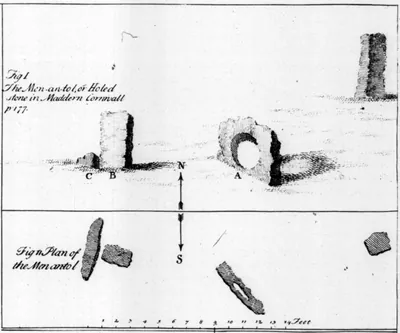
According to the same network, the north-eastern Piper, at 4.6 metres (15 feet), is the tallest standing stone in Cornwall, and the south-western one, at 4.1 metres, is the second tallest. Standing stones like these date from the Bronze Age, and the Pipers were probably put up at about the same time as the circle and linked to it in some way, perhaps marking a ceremonial path. Borlase drew them in 1769 among his single standing stones, which he thought had been raised as idols, memorials or grave-markers.

Close by, on the roadside verge, is Tregiffian, a Neolithic or early Bronze Age entrance grave. Part of its mound now lies under the road. One of the stones at its entrance was carved with 25 small cup-shaped hollows. That stone is now in the Royal Cornwall Museum in Truro, and the one at Tregiffian is a cast copy. Hals heard that a farmer had dug into barrows next to the circle in his day and found urns holding pieces of bone and ashes.

Borlase counted the circle as one of four in West Penwith with exactly nineteen stones each, the others being Boscawen-ûn, Tregeseal and Boskednan. He thought the number had a meaning. Nobody knows why the circle was built, and stone circles are generally thought to have been places for ceremonies. The circle is a scheduled monument, protected by law, but its Historic England entry is one of the oldest kind and gives no description of its own.

Go and See

Where
In a field on the south side of the B3315, about 4 miles (6 km) from Penzance: go past the turning to Lamorna and the circle is about half a mile further on (OS grid reference SW 4327 2451). The Pipers stand in the fields on the other side of the road.
Opening
A public footpath crosses the field to the circle over a stile. There is no public right of way to the Pipers: the Cornish Ancient Sites Protection Network says to ask permission at the farm nearby before going to them. Tregiffian entrance grave is beside the road nearby.
Admission
The circle is on a public footpath, and no charge is mentioned.
Allow
Half an hour to an hour for the circle, the view of the Pipers and Tregiffian.
Parking
A small parking area at the bottom of the field, or the grass verge at the top of the field.
Access
The footpath from the parking area crosses a stile, so there is no step-free access that way. From the verge at the top of the field there is a gate, which could give step-free access if it is unlocked.
Dogs
Keep dogs under effective control and on a lead around farm animals, as the Countryside Code asks, and bag and bin their mess. The circle is in a farmer's field.
Families
A gentle tale for young children, and a good place to count the stones. Please treat the site with respect, and leave no litter and no offerings. If you find any damage, report it to the Cornish Ancient Sites Protection Network.

Visiting details checked 2 November 2026 with The Cornish Ancient Sites Protection Network and Cornwall Heritage Trust. Always check before you travel.

50.0652° N, 5.5888° W · Open in OpenStreetMap

Explore more folklore

All standing stones · All Cornwall legends · The map

Sources

Old books and records

  1. C. S. Gilbert (Charles Sandoe Gilbert), An Historical Survey of the County of Cornwall (vol. 1, 1817), p. 182. The earliest clear record of the story that we have found. Internet Archive.
  2. Davies Gilbert (editor), from the manuscripts of William Hals and Thomas Tonkin, The Parochial History of Cornwall (vol. 1, 1838), “Burian”, p. 141 (Hals's account). William Hals (died 1737) names the Pipers and the “Dance Meyns”, but does not tell the story. Internet Archive.
  3. William Borlase, Antiquities, Historical and Monumental, of the County of Cornwall (1754; second edition, revised and enlarged, 1769), pp. 162, 179, 191, 194 and 199, and Plate X, figs I–II. The circle (Rosmodreuy) and the Pipers described and drawn, with no story; the name Dawns-men; the Hurlers turned to stone. Internet Archive.
  4. J. T. Blight (John Thomas Blight), A Week at the Land's End (1861), pp. 55–56. The story in brief, and the picture of the Pipers. Internet Archive.
  5. Robert Hunt, Popular Romances of the West of England; or, The Drolls, Traditions, and Superstitions of Old Cornwall (first series, 1865), “The Dancing Stones, the Hurlers, &c.”, pp. 192–193. The fullest old telling, and our main source for the tale. Internet Archive.
  6. Robert Hunt, Popular Romances of the West of England, or The Drolls, Traditions, and Superstitions of Old Cornwall (second series, 1865), “Hurling”, pp. 193–194. The hurling run from Buryan Cross to the Pipers. Internet Archive.
  7. William Bottrell, Traditions and Hearthside Stories of West Cornwall (second series, with illustrations by Joseph Blight, 1873), “Celtic Monuments of Boleigh and Rosemodrass”, pp. 29–33. Doubts about the story, the running pipers, and the stones' older name, the Hurlers. Internet Archive.
  8. M. A. Courtney (Margaret Ann Courtney), Cornish Feasts and Folk-Lore (1890), p. 77. Internet Archive.

Places and archaeology

  1. Cornish Ancient Sites Protection Network, “The Pipers Standing Stones”. The Pipers, and access to them. Checked 2 November 2026. cornishancientsites.com.
  2. Cornwall Heritage Trust, “Tregiffian Burial Chamber”. Tregiffian entrance grave. Checked 2 November 2026. cornwallheritagetrust.org.
  3. Historic England, “The Merry Maidens (or Dawns Men) stone circle”, National Heritage List for England, entry 1006731. Its scheduling. Checked 3 November 2026. historicengland.org.uk.

Visiting information

  1. Cornish Ancient Sites Protection Network, “Merry Maidens Stone Circle”. The circle's history, and visiting details. Checked 2 November 2026. cornishancientsites.com.
  2. Natural England and Natural Resources Wales, “The Countryside Code: advice for countryside visitors”, GOV.UK. Dogs on paths and farmland. Checked 2 November 2026. gov.uk.

Pictures

  1. Picture: The Pipers, drawn by J. T. Blight, from A Week at the Land's End (1861). Public domain, via the Internet Archive.

This is a legend, told as people told it. Spotted something wrong? Tell us.